

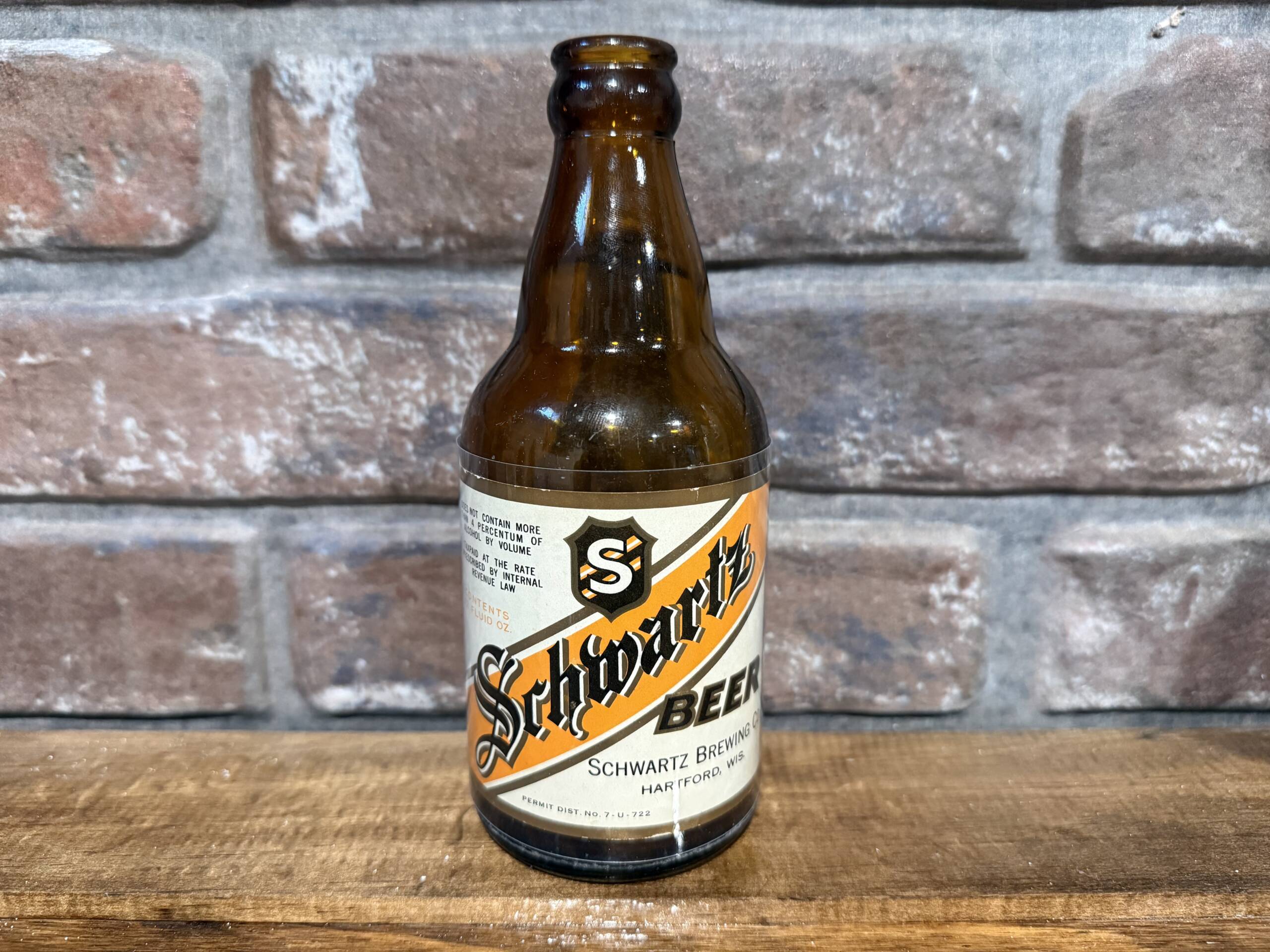
Long before national jazz acts filled a massive dance hall and before Kissel automobiles rolled out of local factories, beer was brewing at 200 E. Wisconsin St. in Hartford.
For nearly 70 years, the site was home to what became the Joseph Schwartz Brewing Company, one of Hartford, Wisconsin’s most significant pre-Prohibition breweries.
Early Brewing in Hartford (1860s–1874)
Brewing in Hartford began before the Civil War era ended. Nicholas Metzer operated the town’s earliest documented brewery prior to 1867. By 1870, the operation produced 400 barrels annually — the lowest-priced beer in Washington County at $7.50 per barrel.
Ownership changed hands in 1871 when John Huels purchased the brewery. Production declined over the next two years, and in 1874 the property was traded to Jacob Portz.
Jacob Portz and the Hartford City Brewery
Under Jacob Portz, the Hartford City Brewery expanded rapidly. Production rose from just 94 barrels in 1874 to 700 barrels annually by the late 1870s.
During the 1880s, Portz added a malt house, transforming the operation into both a brewery and malting facility. In 1890, the business formally incorporated as the Jacob Portz Brewing & Malt Co.
By the mid-1890s, the business split among Portz’s sons. George Portz operated the brewery, while Louis and Andrew managed the malting plant.
Joseph Schwartz Purchases the Brewery (1901)
In 1901, Joseph Schwartz purchased the brewery for $34,000 and began modernizing operations. The company was later incorporated as the Joseph Schwartz Brewing Company.
Schwartz, a Civil War veteran who served with the 1st Wisconsin Volunteers, brewed beer according to traditional German purity standards, using only hops and barley malt.
One of Schwartz’s most notable innovations was investing in motorized delivery. In 1912, he purchased a two-ton truck from the Kissel Motor Car Company. The vehicle famously survived a crash into a mill pond in 1913 and was quickly returned to service — a story featured in a national trade publication.
In addition to brewing, Schwartz operated a large ice business, harvesting ice from Pike Lake before investing in mechanical refrigeration.
Prohibition and the Schwartz Ballroom (1920–1933)
When Prohibition began in 1920, brewing operations ceased. Like many Wisconsin breweries, the Schwartz family diversified.
The company purchased Eagles Park and, in 1928, constructed a massive octagonal dance hall known as “The Schwartz.” At the time, it was reportedly the largest ballroom in Wisconsin.
National touring acts performed there, including Duke Ellington, Benny Goodman and Lawrence Welk.
The ballroom later became Camp Hartford, a World War II detention facility for German prisoners of war, and has since been restored as the Chandelier Ballroom.
Repeal, Decline and Closure (1933–1941)
After the repeal of Prohibition in 1933, the brewery resumed beer production. However, sales never returned to pre-1920 levels.
By 1937, monthly production had fallen below 100 barrels. The brewery ceased operations that summer and filed for bankruptcy. The company was officially dissolved by the state of Wisconsin in 1941.
Have any Hartford Beer memorabilia?
Do you have any Schwartz or Hartford beer memorabilia you are looking to sell? Contact me at contact@danthebeerman.com or reach out via Facebook.
Pictured Above: A steinie bottle from Schwartz Brewing from the 1930s.
